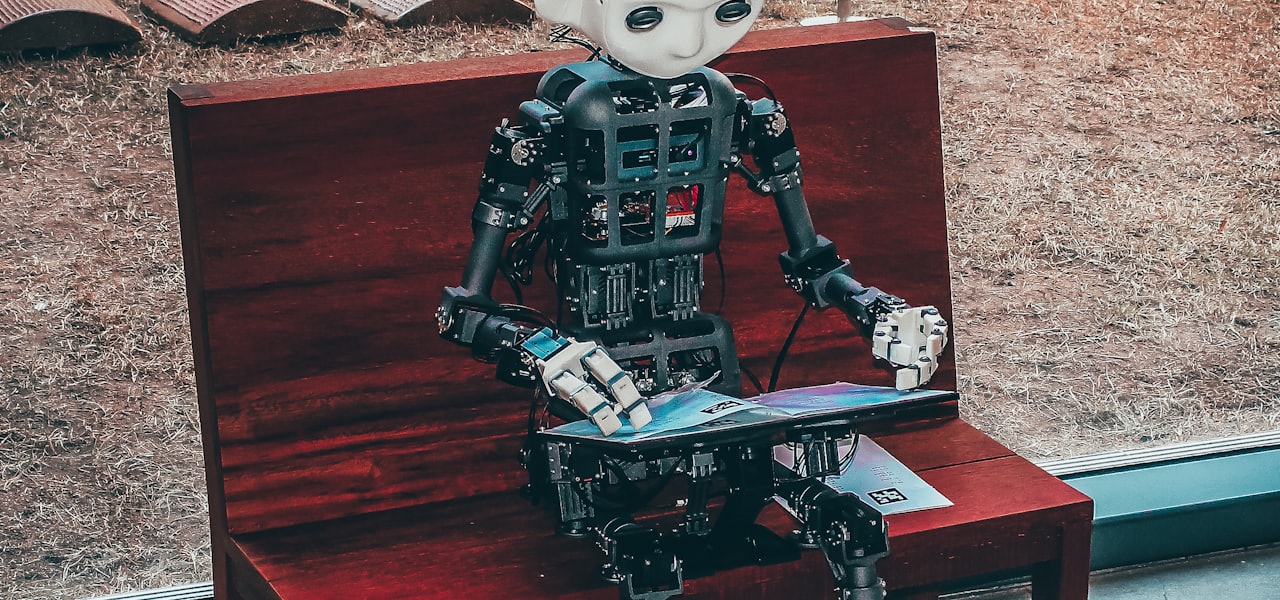
The Stories of Ibis (アイの物語, Ai no Monogatari) is a Japanese science-fiction light novel by Hiroshi Yamamoto (山本 弘) and translated by Takami Nieda. Yamamoto considered this to be an easier read than his earlier science fiction novel 'God Never Keeps Silent' because of its "light novel touch". The light novel was published in Japanese by Kadokawa Shoten and in English by Viz Media under their 'Haikasoru' imprint. The Stories of Ibis is told through a collection of short stories. All but two had been previously published. The two that Yamamoto wrote for the novel were 'The Day Shion Came' and 'AI's Story'. This is similar to The Illustrated Man by Ray Bradbury. Yamamoto drew from Bradbury's idea of short stories that were loosely connected. He represented this influence in the novel by giving Ibis a facial tattoo. == Plot == The Stories of Ibis begins with a wandering storyteller who encounters Ibis. He has the mindset that all robots are a threat to humanity and must be fought against for survival. He attacks the robot Ibis, not aware of who she is, as a result of his mindset. Ibis tells the storyteller that she is far more proficient in battle. During the battle the storyteller becomes injured and Ibis takes him to an android hospital to care for him. While he is recovering Ibis offers to tell him stories. While originally skeptical he agrees after Ibis makes it clear that the stories are not taboo. The space after each story is referred to as intermission and is a time for Ibis to comment on the story she just told. === The Universe on my Hands === The story is about a group of friends who are writing a science fiction story over the internet. One of the group members kills someone in real life. The rest of the short story is about how the group fights to convince this man to not commit suicide, but to turn himself in. He resolves to turn himself in, being hopeful to the future because he knows he has friends who care about him. The ending words of the story are a commentary. While the story they were writing was not real, the emotions they were feeling were real. === A Romance in Virtual Space === This is another story about human interactions over the internet. The device that allows people to enter virtual reality (VR) is MUGEN Net. Such devices are extremely expensive and most people need to go to a public server to use one. However the girl's parents in this story are wealthy enough to own one. This girl is shopping in VR when a boy meets her and asks her out for ice cream. All goes well and they plan for another. After some time of VR dating and awesome adventures with a female heroine, they agree to meet up in real life. He discovers that in reality, she is blind, yet he thinks she is brave and they continue dating. It's a wonderful short story of a secret utopia inside a dystopian culture of technology. === Mirror Girl === A short story about an artificial intelligence that grows over time with human interaction. The inspiration for this story was Ray Bradbury's I Sing the Body Electric. The mirror girl Shalice starts off with basic knowledge and by interacting with her owner develops. The owner grows up and marries a technician who incubates Shalice by teaching her in the virtual world at many thousand times faster than average life. When he is done, Strong Eye is created. Strong Eye is the fully developed and completely intelligent AI. === Black Hole Diver === A futuristic story about an artificial space station and people who go diving into a black hole. The space station cannot stop people but is sorry that they go to their deaths because none of them get past the event horizon. Then one girl comes who has the space ship, the training, and the research necessary to attempt to dive into the black hole. As she goes into the black hole the space station can no longer observe. She may have made it, she could have been destroyed. === A World Where Justice is Just === An anime flavored story about the intelligence of people being scanned onto a computer network. The AIs in the network fight crime and live repeating lives. At the end of each year they start anew, but different story lines. Thousands of 'extras' populate the network and are the ones subject to harm and deletion. The protagonist has a pen pal in real life who explains to her that the real world is under attack and that there are no respawns and no extras. The AI finds this so cruel that people would willingly kill each other when they can't come back. === The Day Shion Came === The stories leading up to this were all relatively short. This and the next took up over 100 pages each. This is a story about an android named Shion who works in a Japanese nursing facility. Shion comes with only extensive nursing training but lacks the knowledge of how to communicate with the residents. After months of training she informs her adviser that she believes all humans have dementia, which explains their irrational behavior. Near the end of the story one of the residents threatens suicide but Shion convinces him to step down and be rational. === AI's Story === The culminating story of the entire novel. It is about Ibis herself. She starts off as a virtual reality fighting program and over time develops intelligence. Her master gains enough funds to create her a body in the real world or level 0. There is significant hate against TAIs (True Artificial Intelligence) in the real world. Ibis and her friend Raven rebel against their masters to make a point. Human hatred was destroying them. After many years robots took prevalence and most humans realized they were not worthy to be the guardians of Earth and died in peace. The remaining population was stubborn and fought against the robots for centuries. The storyteller is a child of this generation, being raised in hatred and ignorance. The robots sought to take him captive, and teach him the truth so that he could go to the villages where people lived and teach them the truth. The whole point was they cared for the humans and wanted them to live in peace, rather than fighting for their survival. == Reception == It was reviewed by the Denver Post to be an "excellent novel". Being a Japanese novel translated to English, it has a small audience. The novel was given a 3.85 of 5 by the reviewers at Librarything.com. The reviewers of Google Books gave it a 4.33 of 5.
KE Software
KE Software is a formerly Australian-owned computer software company based in Manchester, United Kingdom, which specialises in collection management programs for museums, galleries and archives. The Axiell Group acquired the firm in 2014. == History == KE Software had its origins in investigations into electronic systems for managing natural science collections conducted in the late 1970s under a joint program of the University of Melbourne, the then National Museum of Victoria and the Australian Museum, which led to the development of the Titan Database in 1984. Much of the credit for the development of the project was due to the work of Martin Hallett of the Museum of Victoria which evolved into Textpress, and by 2000, the KE EMu database program. KE Software was bought by Axiell in 2014 and the team merged with the Axiell staff. Axiell continues to sell and support EMu. == Products == The firm has two main products: the Ke EMu Electronic Museum management system, a collections management system for museums; and Vitalware Vital Records Management System. The first version of Ke EMu was launched in 1997 and uses the Texpress database engine with client/server architecture on a Windows or Unix/Linux server. Ke Emu is consistent with the Dublin Core / Darwin Core standards for archive and museum catalogue metadata. "The company’s clients include the three largest museums in the world.: == KE EMu == KE EMu is considered one of the more effective and purpose-designed museum cataloguing programs. particularly in the creation of public interfaces to museum catalogue data. KE EMu was further developed in 1997 as a multilingual platform, which has been utilised in bilingual institutions such as the Canadian Museum of Civilisation. Subsequently this evolved into Texpress and KE EMu (standing for Electronic MUseum) in 2000, which is "now used across the world in natural science museums with huge collections'". KE EMu is used by a large number of museums and galleries around the world, including the Smithsonian Anthropological Collection, American Museum of Natural HistoryVancouver Art Gallery, New York Botanical Garden, the University of Chicago Research Archives, the University of Pennsylvania Museum in Philadelphia, the National Museum of Australia, the Australian Museum, Museum of Victoria, University of Melbourne Archives, and the Alexander Turnbull Library, National Library of New Zealand. There are over 300 clients, and more than 5000 users of the EMu software worldwide. The program has been described as providing "...comprehensive museum management (collection management plus other administrative needs for a museum), workflow and project management, flexible metadata, various stats and metrics, and comprehensive web interface with support for mobile devices and kiosks" == KE Vitalware == The firm's vitalware software is used by a number of governments and commercial organisations for managing and accessing large data sets, such as the birth records of the Trinidad and Tobago Registrar General, the Government of Anguilla, Ministry for Infrastructure, Communications, Utility and Housing, and the Mississippi Department of Information Technology Services. == Further development == A specialist tracking component for KE EMu has been developed by Forbes Hawkins of Museum Victoria. This enables locations to be barcoded, and data to be updated as items are moved around the stores, or between venues, display, laboratories and other locations. This system has been considered by Museums around the world. The company has been working with Australian government agencies to digitize birth deaths and marriage registers in order to cross match identity data. The program has also been used for managing the Australian Plant Disease Database and the Australian Plant Pest Database as the program "...has several features that have proven to be invaluable for a plant disease database".
The Future of Work and Death
The Future of Work and Death is a 2016 documentary by Sean Blacknell and Wayne Walsh about the exponential growth of technology. The film showed at several film festivals including Raindance Film Festival, International Film Festival Rotterdam, Academia Film Olomouc and CPH:DOX. In May 2017 it received an official screening at the European Commission. It was distributed by First Run Features and Journeyman Pictures and was released on iTunes, Amazon Prime and On-demand on 9 May 2017. The film was made available on Sundance Now on 27 November 2017. A companion piece to the film, The Cost of Living, a documentary concerning universal basic income in Britain, was released on Amazon Prime on 8 October 2020. == Synopsis == World experts in the fields of futurology, anthropology, neuroscience, and philosophy consider the impact of technological advances on the two 'certainties' of human life; work and death. Charting human developments from Homo habilis, past the Industrial Revolution, to the digital age and beyond, the film looks at the shocking exponential rate at which mankind has managed to create technologies to ease the process of living. As we embark on the next phase of our adaptation, with automation and artificial intelligence signifying the complete move from man to machine, the film asks what the implications are for human fulfilment in an approaching era of job obsolescence and extreme longevity. == Cast == Dudley Sutton – Narrator Aubrey de Grey – Biomedical gerontologist and CSO of the SENS Research Foundation Will Self – Writer, journalist, political commentator and Professor of Contemporary Thought at Brunel University Rudolph E. Tanzi – Professor of Neurology at Harvard University and Director of the Genetics and Aging Research Unit at Massachusetts General Hospital (MGH) Martin Ford – Futurist and author Steve Fuller – Auguste Comte Chair in Social Epistemology at the Department of sociology at University of Warwick Murray Shanahan – Professor of Cognitive Robotics at Imperial College London Gray Scott – Futurist, executive producer of this production Vivek Wadhwa – Entrepreneur, academic and Director of Research at the Center for Entrepreneurship and Research Commercialization at the Pratt School of Engineering, Duke University Zoltan Istvan – Transhumanist and journalist Joanna Cook – Anthropologist, University College London Nicholas Kamara – Physician, Kable Hospital David Pearce – Transhumanist philosopher and co-founder of Humanity+ Peter Cochrane – Futurist and entrepreneur John Harris – Bioethicist, philosopher and Director of the Institute for Science, Ethics and Innovation at the University of Manchester Riva Melissa-Tez – Entrepreneur and transhumanist Ian Pearson – Futurologist Stuart Armstrong – Artificial intelligence researcher at Future of Humanity Institute
Scan line
A scan line (also scanline) is one line, or row, in a raster scanning pattern, such as a line of video on a cathode-ray tube (CRT) display of a television set or computer monitor. On CRT screens the horizontal scan lines are visually discernible, even when viewed from a distance, as alternating colored lines and black lines, especially when a progressive scan signal with below maximum vertical resolution is displayed. This is sometimes used today as a visual effect in computer graphics. The term is used, by analogy, for a single row of pixels in a raster graphics image. Scan lines are important in representations of image data, because many image file formats have special rules for data at the end of a scan line. For example, there may be a rule that each scan line starts on a particular boundary (such as a byte or word; see for example BMP file format). This means that even otherwise compatible raster data may need to be analyzed at the level of scan lines in order to convert between formats.
Adobe ImageReady
Adobe ImageReady was a bitmap graphics editor that was shipped with Adobe Photoshop for six years. It was available for Windows, Classic Mac OS and Mac OS X from 1998 to 2007. ImageReady was designed for web development and closely interacted with Photoshop. == Function == ImageReady was designed for web development rather than effects-intensive photo manipulation. To that end, ImageReady has specialized features such as animated GIF creation, image compression optimization, image slicing, adding rollover effects, and HTML generation. Photoshop versions with which ImageReady was released have an "Edit in ImageReady" button that enables editing of image directly in ImageReady. ImageReady, in turn, has an "Edit in Photoshop" button. ImageReady has strong resemblances to Photoshop; it can even use the same set of Photoshop filters. One set of tools that does not resemble the Photoshop tools, however, is the Image Map set of tools, indicated by a shape or arrow with a hand that varied depending upon the version. This toolbox has several features not found in Photoshop, including: Toggle Image Map Visibility and Toggle Slice Visibility tools: toggle between showing and hiding image maps and slices, respectively Export Animation Frames as Files option: saves all or specified frames for an alternate use, e.g., to e-mail slides for review Preview Document tool: provides a preview of rollover effects in ImageReady rather than previewing them in a browser Preview in Default Browser tool: previews the image in a browser, including any rollover or animation effects Edit in Photoshop button: opens the current image in Photoshop == History == Adobe ImageReady 1.0 was released in July 1998 as a standalone application. Version 2.0 was packaged with Photoshop 5.5, and the program was included with Photoshop through version 9.0 (CS2). Starting with Photoshop 7.0, Adobe changed the version numbers of ImageReady to match. With the release of the Creative Suite 3, ImageReady was discontinued. According to Adobe, ImageReady's most popular features were merged into Photoshop. (Even before discontinuation, some of ImageReady's web optimization functionality could be found in Photoshop's Save For Web & Devices tool.) Around the same time, Adobe purchased rival software developer Macromedia, whose application Fireworks had been a competitor to ImageReady.
International Medical Education Directory
The International Medical Education Directory (IMED) was a public database of worldwide medical schools. The IMED was published as a joint collaboration of the Educational Commission for Foreign Medical Graduates (ECFMG) and the Foundation for Advancement of International Medical Education and Research (FAIMER). The information available in IMED was derived from data collected by the Educational Commission for Foreign Medical Graduates (ECFMG) throughout its history of evaluating the medical education credentials of international medical graduates. Using these data as a starting point, Foundation for Advancement of International Medical Education and Research (FAIMER) began developing IMED in 2001 and made it publicly available in April 2002. In April 2014, IMED was merged with the Avicenna Directory to create the World Directory of Medical Schools. The World Directory is now the definitive list of medical schools in the world, as IMED and Avicenna were discontinued in 2015.
Turret lathe
A turret lathe is a form of metalworking lathe that is used for repetitive production of duplicate parts, which by the nature of their cutting process are usually interchangeable. It evolved from earlier lathes with the addition of the turret, which is an indexable toolholder that allows multiple cutting operations to be performed, each with a different cutting tool, in easy, rapid succession, with no need for the operator to perform set-up tasks in between (such as installing or uninstalling tools) or to control the toolpath. The latter is due to the toolpath's being controlled by the machine, either in jig-like fashion, via the mechanical limits placed on it by the turret's slide and stops, or via digitally-directed servomechanisms for computer numerical control lathes. The name derives from the way early turrets took the general form of a flattened cylindrical block mounted to the lathe's cross-slide, capable of rotating about the vertical axis and with toolholders projecting out to all sides, and thus vaguely resembled a swiveling gun turret. Capstan lathe is the usual name in the UK and Commonwealth, though the two terms are also used in contrast: see below, Capstan versus turret. == History == Turret lathes became indispensable to the production of interchangeable parts and for mass production. The first turret lathe was built by Stephen Fitch in 1845 to manufacture screws for pistol percussion parts. In the mid-nineteenth century, the need for interchangeable parts for Colt revolvers enhanced the role of turret lathes in achieving this goal as part of the "American system" of manufacturing arms. Clock-making and bicycle manufacturing had similar requirements. Christopher Spencer invented the first fully automated turret lathe in 1873, which led to designs using cam action or hydraulic mechanisms. From the late-19th through mid-20th centuries, turret lathes, both manual and automatic (i.e., screw machines and chuckers), were one of the most important classes of machine tools for mass production. They were used extensively in the mass production for the war effort in World War II. The U.S. company Warner & Swasey was one of the premier brands in heavy turret lathes between the 1910s and 1960s; it became the world's largest manufacturer of such lathes by 1928. During World War II, it employed 7,000 people and produced half of the turret lathes manufactured in the United States. == Types == There are many variants of the turret lathe. They can be most generally classified by size (small, medium, or large); method of control (manual, automated mechanically, or automated via computer (numerical control (NC) or computer numerical control (CNC)); and bed orientation (horizontal or vertical). === Archetypical: horizontal, manual === In the late 1830s a "capstan lathe" with a turret was patented in Britain. The first American turret lathe was invented by Stephen Fitch in 1845. The archetypical turret lathe, and the first in order of historical appearance, is the horizontal-bed, manual turret lathe. The term "turret lathe" without further qualification is still understood to refer to this type. The formative decades for this class of machine were the 1840s through 1860s, when the basic idea of mounting an indexable turret on a bench lathe or engine lathe was born, developed, and disseminated from the originating shops to many other factories. Some important tool-builders in this development were Stephen Fitch; Gay, Silver & Co.; Elisha K. Root of Colt; J.D. Alvord of the Sharps Armory; Frederick W. Howe, Richard S. Lawrence, and Henry D. Stone of Robbins & Lawrence; J.R. Brown of Brown & Sharpe; and Francis A. Pratt of Pratt & Whitney. Various designers at these and other firms later made further refinements. === Semi-automatic === Sometimes machines similar to those above, but with power feeds and automatic turret-indexing at the end of the return stroke, are called "semi-automatic turret lathes". This nomenclature distinction is blurry and not consistently observed. The term "turret lathe" encompasses them all. During the 1860s, when semi-automatic turret lathes were developed, they were sometimes called "automatic". What we today would call "automatics", that is, fully automatic machines, had not been developed yet. During that era both manual and semi-automatic turret lathes were sometimes called "screw machines", although we today reserve that term for fully automatic machines. === Automatic === During the 1870s through 1890s, the mechanically automated "automatic" turret lathe was developed and disseminated. These machines can execute many part-cutting cycles without human intervention. Thus the duties of the operator, which were already greatly reduced by the manual turret lathe, were even further reduced, and productivity increased. These machines use cams to automate the sliding and indexing of the turret and the opening and closing of the chuck. Thus, they execute the part-cutting cycle somewhat analogously to the way in which an elaborate cuckoo clock performs an automated theater show. Small- to medium-sized automatic turret lathes are usually called "screw machines" or "automatic screw machines", while larger ones are usually called "automatic chucking lathes", "automatic chuckers", or "chuckers". Such machine tools of the "automatic" variety, which in the pre-computer era meant mechanically automated, had already reached a highly advanced state by World War I. === Computer numerical control === When World War II ended, the digital computer was poised to develop from a colossal laboratory curiosity into a practical technology that could begin to disseminate into business and industry. The advent of computer-based automation in machine tools via numerical control (NC) and then computer numerical control (CNC) displaced to a large extent, but not at all completely, the previously existing manual and mechanically automated machines. Numerically controlled turrets allow automated selection of tools on a turret. CNC lathes may be horizontal or vertical in orientation and mount six separate tools on one or more turrets. Such machine tools can work in two axes per turret, with up to six axes being feasible for complex work. === Vertical === Vertical turret lathes have the workpiece held vertically, which allows the headstock to sit on the floor and the faceplate to become a horizontal rotating table, analogous to a huge potter's wheel. This is useful for the handling of very large, heavy, short workpieces. Vertical lathes in general are also called "vertical boring mills" or often simply "boring mills"; therefore a vertical turret lathe is a vertical boring mill equipped with a turret. == Other variations == === Capstan versus turret === The term "capstan lathe" overlaps in sense with the term "turret lathe" to a large extent. In many times and places, it has been understood to be synonymous with "turret lathe". In other times and places it has been held in technical contradistinction to "turret lathe", with the difference being in whether the turret's slide is fixed to the bed (ram-type turret) or slides on the bed's ways (saddle-type turret). The difference in terminology is mostly a matter of United Kingdom and Commonwealth usage versus United States usage. === Flat === A subtype of horizontal turret lathe is the flat-turret lathe. Its turret is flat (and analogous to a rotary table), allowing the turret to pass beneath the part. Patented by James Hartness of Jones & Lamson, and first disseminated in the 1890s, it was developed to provide more rigidity via requiring less overhang in the tool setup, especially when the part is relatively long. === Hollow-hexagon === Hollow-hexagon turret lathes competed with flat-turret lathes by taking the conventional hexagon turret and making it hollow, allowing the part to pass into it during the cut, analogously to how the part would pass over the flat turret. In both cases, the main idea is to increase rigidity by allowing a relatively long part to be turned without the tool overhang that would be needed with a conventional turret, which is not flat or hollow. === Monitor lathe === The term "monitor lathe" formerly (1860s–1940s) referred to the class of small- to medium-sized manual turret lathes used on relatively small work. The name was inspired by the monitor-class warships, which the monitor lathe's turret resembled. Today, lathes of such appearance, such as the Hardinge DSM-59 and its many clones, are still common, but the name "monitor lathe" is no longer current in the industry. === Toolpost turrets and tailstock turrets === Turrets can be added to non-turret lathes (bench lathes, engine lathes, toolroom lathes, etc.) by mounting them on the toolpost, tailstock, or both. Often these turrets are not as large as a turret lathe's, and they usually do not offer the sliding and stopping that a turret lathe's turret does; but they do offer the ability to index through successive tool